
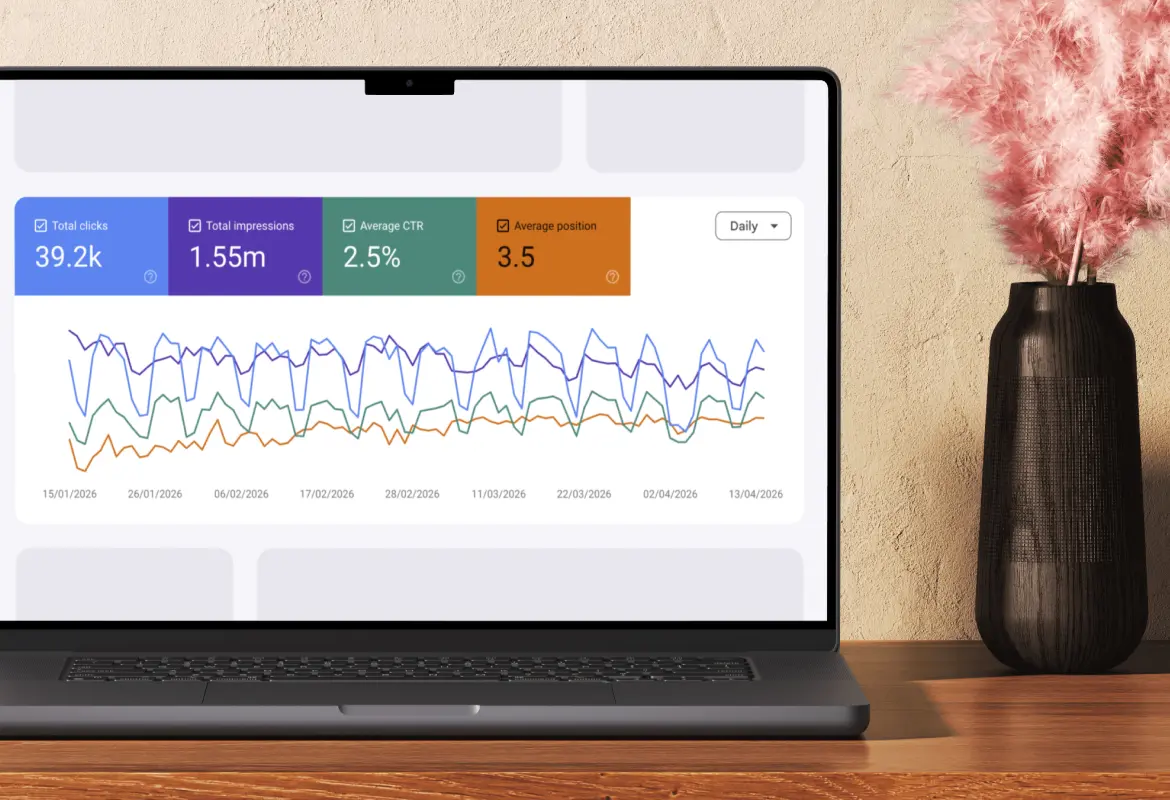
Traditionally, SEO reporting has relied heavily on rankings. Businesses have wanted to know whether they were on page one, whether they had moved up or down and whether they had managed to secure the top position for the keywords that mattered.
That way of thinking still has value. Rankings remain a useful signal, and they are often a practical way to understand whether a website is becoming more or less relevant for a particular search term. But SEO performance now needs to be understood in a broader context.
The search results page has become much more complex. A result may now include paid ads, shopping results, maps, videos, featured snippets, AI-generated summaries, product carousels, forums, reviews and other search features before a user reaches the traditional organic listings.
Rankings still matter, but they no longer tell the full story. A business can rank well and still be pushed out of sight by ads, AI summaries, product features and other search results.
Recent industry analysis presented at BrightonSEO focused on the way pixel height and SERP features affect how much visible space organic listings actually receive, with the core point being that marketers need to think about search visibility as well as rank.
For any business that relies on search to generate enquiries, sales or brand awareness, the practical implication is clear. SEO performance needs to be measured by visibility, not rankings alone.
A high ranking does not always mean high visibility
A number one ranking used to be relatively easy to understand. If you were first, you were usually the first meaningful organic result a user saw. That is no longer always true.
In many searches, the first organic listing can be pushed lower down the page by paid placements, AI summaries, product features or other search modules. On mobile, where screen space is limited, that matters even more. A user experiences the search results page visually. They see what appears first, what takes up space, what looks credible and what answers their question quickly.
That means a ranking report may say a business is in position one, while the actual search experience presents a more complicated picture. If the user has to move past ads, AI-generated content, product results or other features before seeing the website, the commercial value of that ranking may be lower than the report suggests.
Coverage of the BrightonSEO analysis made this point directly: there is less value in ranking first if the searcher has to scroll past ads and AI features before seeing the result.
This does not mean rankings are irrelevant. It means they need to be interpreted in context. A ranking is one signal. Visibility is the more useful commercial measure.
Why visibility is becoming the better measure
Visibility asks a more practical question than rank. It looks at whether a brand is actually present in the places where the user is paying attention.
That might include a traditional organic result, but it might also include a paid search ad, a map listing, a product result, a YouTube video, a Reddit thread, a review site, an AI answer or a social platform. It may also include branded searches that happen later, after the user has first encountered the business somewhere else.
For businesses, this means SEO reporting should begin to account for more than keyword movement. It should consider how the brand appears across the search experience, what appears above and around the website result, whether competitors are taking more of the visible space and whether the business is being surfaced in formats beyond its own website.
A more useful set of questions might include:
- How visible are we above the fold?
- What search features appear before our website result?
- Are competitors occupying more visual space than we are?
- Are we present in AI-generated answers or summaries?
- Are we visible across organic, paid, local, video and social search?
- Are rankings translating into qualified traffic, enquiries or brand demand?
This is a more commercially realistic view of search. It recognises that being ranked is not the same as being seen.
Search behaviour is changing as well
The search results page is only part of the change. The way people search is also evolving.
Google remains important, but people no longer use Google for every discovery task. Different platforms are used for different moments in the same decision. A person might use TikTok or Instagram for inspiration, YouTube for explanation, Reddit for unfiltered opinions, Google for comparison, ChatGPT for synthesis and a company website for final validation.
Search is no longer just a search engine behaviour. It is how people discover, compare, validate and decide across multiple platforms.
This behaviour is becoming more visible in the data. Sprout Social's 2025 research found that 41% of Gen Z users turn to social platforms first when looking for information, ahead of traditional search engines at 32% and chat-based AI tools at 11%.
That creates a challenge for businesses that still think about SEO as a Google-only discipline. If customers are searching across multiple environments, the strategy needs to account for that behaviour. Your brand needs to be findable, useful and credible across more than one kind of search experience.
This does not mean every business needs to be everywhere. It means each business needs to understand where its audience searches, what job the user is trying to complete and what format is most useful in that moment.
SEO cannot sit in isolation
For many businesses, SEO has historically been treated as a channel. It has sat alongside paid media, content, social, website management and brand. That model is becoming less useful.
Search visibility now depends on the strength of the entire digital presence. Technical SEO still matters. Website structure still matters. Content quality still matters. But so do brand authority, social proof, video content, third-party mentions, reviews, PR, social search, paid visibility and the quality of the website experience once someone arrives.
Reflect Digital's SearchPulse research describes the current environment as a fractured search ecosystem where AI and social media have changed how people find and evaluate information. That framing is useful because it recognises that search is no longer only a search engine behaviour. It is a discovery behaviour that appears across many platforms.
A technically optimised website with thin content may struggle. A strong content strategy without technical foundations may also struggle. A business with good rankings but poor brand recognition may lose out to a competitor that appears more credible across more touchpoints.
The strongest search strategies now connect SEO with broader digital activity. They consider how a brand is discovered, how it is evaluated and how the website supports the final decision.
The role of clicks is changing
Clicks are still important, especially when they lead to enquiries, purchases, bookings or other meaningful actions. But clicks are not the only way search creates value.
In many modern search experiences, users receive information before they click. They might read an AI summary, scan a featured snippet, watch a short video, see a product comparison or notice a brand mentioned in a forum. That interaction may not appear as a website visit, but it can still influence what the user thinks and what they do next.
Pew Research Center’s 2025 analysis of Google AI summaries found that users clicked a traditional search result in 8% of visits when an AI summary appeared, compared with 15% of visits when no AI summary was shown. Pew also found that AI summaries appeared in 18% of the Google searches it analysed in March 2025.
SparkToro and Datos have also reported how much search activity does not result in a click to the open web.
Their 2024 zero-click study found that for every 1,000 Google searches in the European Union, only 374 clicks went to the open web. In the United States, the figure was 360.
This does not make SEO less important. It does mean the measurement model needs to mature. If fewer searches result in a traditional click, businesses need to understand the value of visibility, impressions, mentions, branded demand and assisted conversion, not just last-click traffic.
This is uncomfortable if SEO is measured only through sessions and conversions, but it is not a new idea in marketing. Brand exposure has always had value even when it does not create an immediate action. Outdoor, TV, print and radio have long operated on the basis that repeated, credible presence influences future decisions. Search is now moving closer to that model.
Useful data points
| Topic | Data point | Why it matters |
|---|---|---|
| SERP visibility | BrightonSEO covered pixel-height data and how organic results compete with SERP features for visible space. | Ranking does not always equal visibility. (Source) |
| SERP visibility | A BrightonSEO roundup noted that ranking first has less value if users must scroll past ads and AI features to see the result. | Position needs to be considered in the context of the whole results page. (Source) |
| Social search | Sprout Social found that 41% of Gen Z users turn to social platforms first when looking for information. | Search behaviour is moving across platforms, especially for younger audiences. (Source) |
| AI summaries | Pew found users clicked a traditional search result in 8% of visits when an AI summary appeared, compared with 15% when no AI summary appeared. | AI search features can reduce traditional click behaviour. (Source) |
| AI summaries | Pew found AI summaries appeared in 18% of Google searches analysed in March 2025. | AI summaries are no longer a fringe search feature. (Source) |
| Zero-click search | SparkToro and Datos found that for every 1,000 Google searches, 374 clicks in the EU and 360 clicks in the US went to the open web. | Search value should not be measured by clicks alone. (Source) |
| Fragmented search | Reflect Digital describes the current environment as a fractured search ecosystem shaped by AI and social media. | SEO needs to connect with content, social, brand, PR, paid media and website experience. (Source) |
What this means for marketing teams
The practical response is not to abandon SEO or chase every new platform. It is to broaden the way search is planned and measured.
A business should still care about its website, technical performance, content, rankings and conversions. Those fundamentals remain important. But it should also look at whether its brand is visible across the wider decision-making journey.
That means reviewing the actual search results that matter, not just the ranking position. It means understanding whether paid ads, AI summaries, maps, product features or competitors are dominating the visible part of the page. It means looking at how the business appears across YouTube, Reddit, social platforms and AI tools where relevant.
It also means building content that genuinely helps people make decisions. Generic articles written to target keywords are less useful than practical, specific content that answers real questions. Comparison guides, frameworks, checklists, case studies, explainers and expert points of view are more likely to support visibility across both search engines and AI-assisted discovery.
How businesses should adapt their SEO reporting
Monthly SEO reports should still include rankings, but rankings should not be the whole story. A more mature report should connect rankings to visibility, behaviour and commercial value.
Useful reporting may include:
- Keyword rankings by intent and landing page
- Clicks, impressions and click-through rate
- Search result features appearing for priority queries
- Whether key pages appear above or below major SERP features
- Local search visibility
- Paid and organic overlap
- Brand search growth
- Visibility in AI-generated results, where measurable
- Traffic quality and conversion outcomes
- Assisted conversions and returning users
- Content performance across different stages of the buying journey
This gives a more complete view of whether search is helping the business become more visible, more trusted and more likely to be chosen.
Designing for presence
The more useful strategic question is not simply "how do we rank higher?" It is “how do we show up credibly when and where our customers are making decisions?”
A useful search strategy starts by understanding what the user is trying to do in that moment. Someone looking for inspiration does not need the same content as someone comparing providers or preparing a business case. The format should match the job the user is trying to complete.
| User behaviour | Useful format | Why it works |
|---|---|---|
| Inspiration | Short video, social post, visual example or opinion piece | Helps users understand what is possible before they have clearly defined the problem. |
| Research | Detailed guide, explainer, checklist or framework | Gives users depth, structure and practical information as they build confidence. |
| Validation | Reviews, case studies, testimonials or expert commentary | Helps users confirm whether an idea, product, service or provider is credible. |
| Comparison | Comparison page, buyer guide, matrix or FAQ | Helps users weigh up options, understand trade-offs and move closer to a decision. |
| Internal justification | Case study, business case, ROI guide or implementation plan | Gives users evidence and language they can take back to stakeholders. |
| Decision | Service page, pricing guidance, contact page or consultation offer | Reduces friction and makes it easier to enquire, buy or take the next step. |
This is why modern SEO needs to work closely with content strategy, UX, brand and digital marketing. The goal is not to produce more content for the sake of it. The goal is to be present with the right information, in the right format, at the point where it can help someone move forward.
What to do next
Businesses that want to respond to this shift should start with a practical review.
First, look at the search results for your most important commercial queries. Do not just check where you rank. Look at what the user actually sees. Identify the ads, AI summaries, map results, videos, forums and competitors that shape the page.
Second, review whether your priority pages are genuinely useful. A service page should explain what you do, who it is for, what problems you solve, what makes your approach credible and what the user should do next. Thin or generic content is unlikely to perform well in a more competitive search environment.
Third, look beyond your own website. Are you mentioned in credible places? Do you have useful content on platforms your audience uses? Are there reviews, case studies, videos, articles or third-party references that support trust?
Finally, update your measurement. Ranking reports are still useful, but they need to sit inside a broader visibility framework. Track whether your brand is becoming easier to find, easier to understand and easier to trust across the full journey.
The future of SEO is broader than SEO
Search has always changed, but this shift feels more structural than another algorithm update. The search results page is more crowded, user behaviour is more fragmented and AI is changing how people discover and evaluate information.
For businesses, the answer is not to panic or abandon what has worked. The answer is to build a stronger, more connected digital presence.
Rankings still matter. Clicks still matter. Technical SEO still matters. But the brands that perform well in the next stage of search will be those that are visible across the places where people actually form opinions and make decisions.
SEO is no longer only about where you rank. It is about whether your business is present, credible and useful when it matters.