
Trying to understand why your organic clicks are falling? Google is increasingly answering users' questions directly rather than sending them to your website. A study of 100 million keywords confirms what many businesses are already experiencing: organic clicks have fallen by more than 60% and this is not a temporary dip. It is a structural change in how search works.
What's happening to your clicks?
If your organic traffic is falling while your Google Search Console shows steady rankings, you are not imagining it and you are not alone.
We have written separately about how SEO measurement is shifting from rankings to broader visibility, and why a high ranking no longer guarantees a high volume of clicks. This article goes deeper into the specific mechanism driving that shift: Google AI Overviews, the data behind the click decline they have caused, and the practical steps businesses need to take to remain visible.
Google has spent the past two years aggressively rolling out AI Overviews across its search results. These are AI-generated answer summaries that appear at the very top of the page, before any organic listings, synthesising an answer from across the web so that users often do not need to click anywhere at all.
The result is a search results page that now typically looks like this for many queries:
- A large AI-generated summary at the top of the page
- Sponsored ads (sometimes appearing both above and below the AI Overview)
- A "People Also Ask" section
- Organic results, pushed well below the fold
For any result outside the top three, a user may now need to scroll two or three times before seeing your listing at all.
How we got here
For more than 20 years, the relationship between Google and website owners was straightforward and mutually beneficial:
- Google's crawler (Googlebot) visited your site and indexed your content
- Google served your pages to users in search results
- Users clicked through and you earned traffic
- Google monetised those visits with advertising placed around the organic results
You invested in content and Google sent you visitors. Win-Win.
"For about two decades, the relationship between websites and Google ran on a simple, unwritten agreement. Crawlers indexed your content, search results sent visitors, and visitors generated revenue. The exchange worked because both sides profited." - SEO Stack
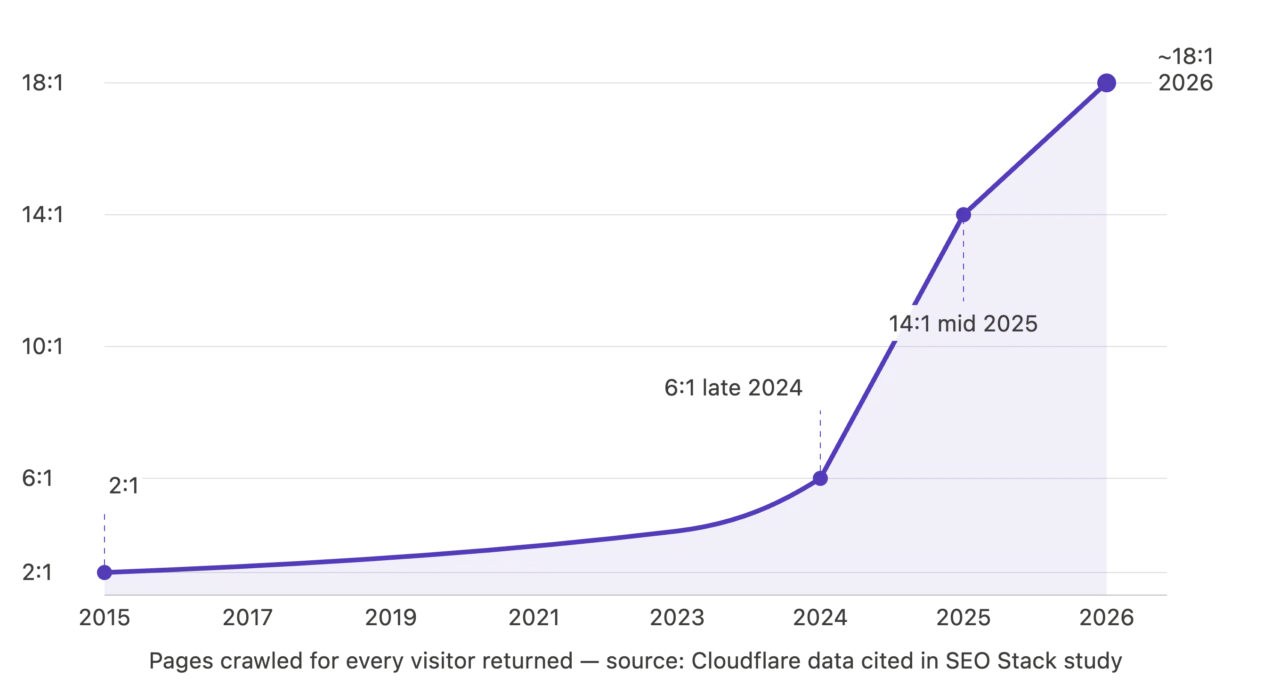
That exchange has now broken down. According to Cloudflare's crawl-to-referral data, Google's crawler went from fetching roughly 2 pages for every visitor it sent a decade ago, to 6:1 in late 2024, to roughly 14:1 by mid-2025, and to around 18:1 by the time Cloudflare's figures were published. Google is consuming more of your content than ever while returning fewer visitors in exchange.
The Data: 100 million keywords with one truth
In June 2026, SEO consultant Daniel Foley Carter published a study analysing over 100 million keywords across hundreds of websites to measure the real impact of AI Overviews on organic click-through rates and the numbers are stark. Here's a quick takeaway: Ranking number one today delivers roughly the same traffic as ranking number three did before AI Overviews launched.
| Metric | Pre-AI Overviews | Post-AI Overviews |
|---|---|---|
| Average clicks to position 1 | Baseline | Down 60%+ |
| Crawl-to-referral ratio (Google) | ~2:1 | ~14 to 18:1 |
| Searches showing AI Overviews | Less than 10% | 50%+ of all searches |
| What position 1 is worth today | Position 1 traffic | Approx. old position 3 traffic |
The impressions trap
One of the most disorienting aspects of this shift is that your Search Console data may actually show more impressions than ever. Your content is appearing in more searches. But those impressions are not converting to clicks the way they used to.
"Impressions have gone through the roof, as have positions 1 to 3. But where are the clicks?" - SEO Stack
This disconnect is creating a real problem for businesses and marketing teams who are being told their SEO is performing well while their actual traffic tells a different story.
Why is Google doing this?
Google's commercial incentive is straightforward. As AI Overviews answer more queries directly, users who do not find what they need in the AI summary have one remaining option i.e. paid search. By compressing organic click-through rates, Google is effectively increasing the commercial value of its paid advertising inventory.
AHREFS data supports the trajectory. Estimated click reduction from AI Overviews went from 34% to 58% in less than a year, and Google shows no sign of slowing the expansion. AI Overviews are now appearing on commercial and transactional searches where they were previously absent, and upcoming features including in-SERP browsing (where users can view website content without ever leaving Google) will push this further.
It's not just Google. ChatGPT and Claude are deciding who gets recommended
The AI Overview problem is the most immediate and measurable, but there is a parallel shift that many businesses have not yet fully accounted for and that is conversational AI search.
A growing number of your potential customers are bypassing Google entirely and directing their questions to ChatGPT, Claude, Perplexity or Microsoft Copilot. These tools are being used to research services, compare providers and shortlist vendors before a user ever visits a website.
When someone asks ChatGPT "which digital marketing agency should I use for SEO in Melbourne," your business either appears in that answer or it does not. There is no page 2 and there is no scrolling down to find you.
This is a fundamentally different kind of search visibility problem to the one Google's rankings created, and it requires a different way of thinking about what it means to be discoverable online.
What AI Tools use to form recommendations
This is where a lot of businesses waste time and money chasing the wrong things.
The tactics that tend to get promoted as "AI SEO" are llms.txt files, .md pages, AEO hacks and writing content specifically "for AI" are secondary signals at best. AI tools do not primarily decide what to recommend based on whether you have an llms.txt file.
Here's what AI tools really draw on:
| Signal | Why it matters |
|---|---|
| Google rankings | AI tools frequently surface content and brands that already rank well in traditional search |
| Reviews | Google Reviews, industry directories and third-party platforms are heavily weighted |
| Earned media | Press coverage, editorial mentions and third-party commentary signal credibility |
| Entity consistency | Having consistent, accurate information about your business across the web helps AI tools recognise and trust your brand |
| Topical authority | Consistently publishing useful, specific content in your niche signals expertise |
| YouTube videos | Increasingly used as a source by AI search tools |
| Owned content | Your own website content remains a foundational signal when it is authoritative and well structured |
| Industry publications | Being featured or cited in sector-relevant publications builds domain credibility |
| Brand mentions | Being referenced in publications, articles and forums, even without a link, builds entity recognition |
| Comparison pages | Content that helps users weigh up options is frequently surfaced by AI tools |
| Community threads | Reddit discussions, LinkedIn posts and forum content are all referenced |
| Third-party recommendations | Being recommended by other credible sources, such as round-ups and directories, strengthens AI visibility |
| Backlinks | Citations from authoritative domains remain a strong trust signal |
The fundamentals of good SEO and a credible online presence are the foundation of AI visibility too. The difference is that distribution now matters as much as creation. Your brand needs to be mentioned and cited across the places AI tools draw from, not just optimised on your own website.
Your action plan: How to show up in the AI Search Era
Here is a practical framework for adapting to this environment. There are no short-term hacks and it's about building the signals that AI tools and search engines use.
1. Target AI Overview inclusion and not just page one rankings
Appearing in a Google AI Overview is not automatic even if you rank in position 1. Google selects sources based on how directly and authoritatively the content answers the specific question.
How to improve your chances:
- Structure content to directly and concisely answer specific questions. Don't just cover topics broadly
- Use H2 and H3 headings that mirror the way users phrase their queries
- Write clear, quotable summaries: AI tools favour confident, specific statements
- Add FAQ schema and How-To schema to help Google parse your content efficiently
- Build topical clusters. A single article is far less effective than a group of interlinked articles that cover a subject in depth
Our SEO services covers how we approach technical and content SEO for clients working to build sustained search visibility.
2. Build topical authority through content clusters
Rather than publishing individual articles in isolation, build connected content clusters around the subjects that matter most to your business. Each cluster should include:
- A core pillar page that covers the topic comprehensively
- A series of supporting articles that go deep on specific subtopics
- Internal links that connect every piece to the others
This signals to both Google and conversational AI tools that your site is a genuine authority on a subject, not simply a single article that happened to rank.
We cover the strategic case for this approach in our article on how SEO is shifting from rankings to visibility.
3. Invest in brand mentions, not just backlinks
Traditional link building focused on getting clickable links from other websites. That still matters, but the new currency is brand mentions across the web, including in places where no link exists at all.
Where to focus:
- Industry publications and trade media
- Guest articles and contributed content in relevant outlets
- PR and earned media (being quoted, featured or referenced editorially)
- LinkedIn content that generates genuine discussion and shares
- Review platforms relevant to your sector
Every credible mention of your brand name on the open web, particularly in editorial contexts, contributes to the entity recognition that AI tools use when deciding who to recommend.
4. Get serious about reviews and third-party credibility
For service businesses, review signals are among the most heavily weighted inputs for AI recommendations. This means:
- Actively and consistently asking clients for Google Reviews
- Maintaining accurate profiles on relevant industry directories
- Encouraging clients to reference you in their own case studies and content
- Pursuing inclusion in comparison and round-up articles ("best digital agencies in Melbourne" and similar)
5. Distribute content beyond your website
YouTube is increasingly used as a source by AI tools. LinkedIn content generates the kind of community discussion and brand signal that conversational AI draws on. Your content strategy needs to think beyond the blog post.
Channels worth building into your plan:
- Short-form video on YouTube and LinkedIn
- Podcast appearances and contributed audio content
- LinkedIn articles and thought leadership posts
- Email newsletters (which generate forward links and citations over time)
6. Reassess paid search as part of the mix
As organic click rates compress, paid search becomes a more important channel for many businesses. Not necessarily more expensive, but more strategically deliberate. The question is which queries you need guaranteed presence on, and how your paid and organic activity can reinforce each other rather than operate in silos.
Our Pay-Per-Click and Google Ads Management services are built to work alongside organic strategy, not in isolation from it.
How Bright Labs can help
At Bright Labs, we have been tracking these shifts closely and building integrated strategies that position clients for search as it actually works today, not as it worked three years ago.
That means connecting SEO, content strategy, paid media and distribution into a single coordinated approach. Not separate channel plans that happen to coexist, but a strategy where each element builds on the others: content that earns rankings, rankings that support AI visibility, AI visibility that builds brand recognition, brand recognition that drives direct and assisted conversions.
If you would like to talk through how your current strategy is holding up in this environment, get in touch with our team.
References
- Google Search Click Decline: A Shocking 60% Decline in Clicks to the Web (June 2026)
- Cloudflare crawl-to-referral ratio data, cited in SEO Stack study
- AHREFS AI Overview click impact studies (2024 to 2025)